-
Seven Game Losing Streaks
I just watched my favorite hockey team lose its seventh game in a row. I could’ve spent my night hanging out with friends, going to dinner with my girlfriend, playing with my dog, reading a book, watching a movie, listening to a record, playing video games, or being disappointed by the outcome of a coin flip. I chose the last one.
In fact, I’ve watched every single game of this losing streak. There’s something stupid about being upset about a game played by people I’ll never meet, but I guess there’s a romance to that too. These men a thousand miles away from me are connected to me in some way. When they raise their hands above their heads in triumph, so do I. When they lose, I’m crushed. Either way, the past two weeks have got me thinking about what the likelihood of a team losing seven games in a row in the NHL is.
To scratch the itch, I sat down with a pen and some paper and tried to scribble out the odds. The first instinct is to say that it’s incredibly rare unless the team is really bad. A team that has a 50-50 chance of winning any given game will win 0 out of 7 games 0.7% of the time. The symmetry there is nice, but that doesn’t make much sense when you look at the history of the NHL. Seven game losing streaks aren’t particularly uncommon.
Since the 2005-2006 season there have been 441 teams that have played 82-game seasons in the NHL. 123 of those teams have had at least one seven game losing streak at some point in the season. Shockingly, 34 of those teams have gone on to have a win percentage of more than 50% at the end of the season. One of those teams even won the Stanley Cup.
But that still doesn’t answer the question of what the theoretical odds of long losing streaks are. It turns out this question is a lot more complicated than it appears on the surface. The complication comes from not just looking at the total number of losses, but also the order that those losses occur. That’s the issue with the 0.7% probability. That number assumes that there’s only one shot to lose seven in a row, but over 82 games there’s plenty more opportunity to disappoint.
It’s easier to see that effect play out over a smaller scale. Instead of an 82-game season, I’ll use a 3-game season. In the place of a seven game losing streak, I’ll look for two game streaks while assuming a 50-50 chance of winning each game. Writing out all of the eight possible combinations of winning or losing over a 3-game season there are three that have two game losing streaks in them. That comes out to a 38% chance. Compared to the one-time odds of 25%, the season-long chance is much higher.
Mark Shilling wrote a fantastic paper about the longest run of heads that gets into it more of the theory. http://www.csun.edu/~hcmth031/tlroh.pdf
There’s a formula in there that could be manipulated to get the result I want, but it’s late and I have access to brute force simulation.
After simulating 10,000 82-game seasons for each theoretical win percentage from 0% to 100%, I have the definitive graph of seven game losing streak probabilities.
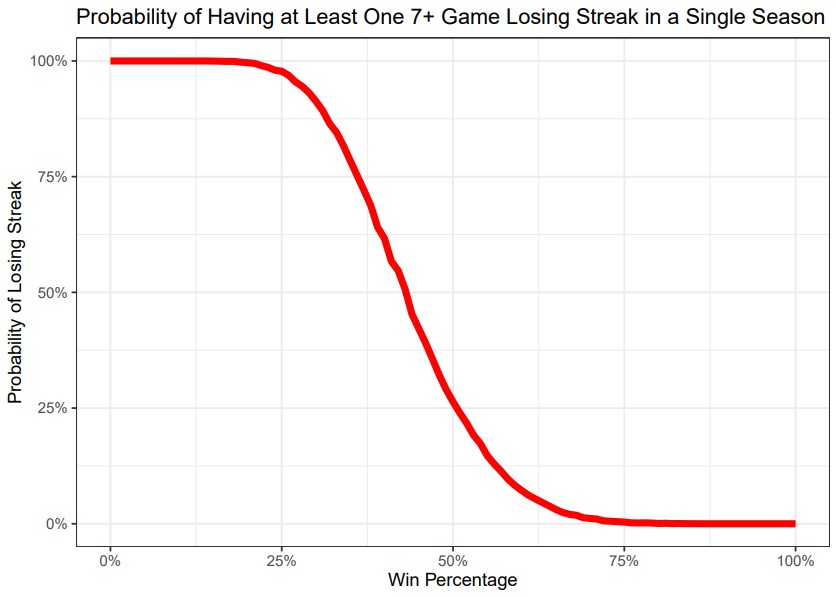
To be very clear about what’s being shown, these are the odds of observing at least one losing streak of at least seven games in a single 82-game NHL season. But more importantly, it helps support the idea that there’s still a chance my team is good. I mean even a team with a 57% chance of winning every game is going to have a 10% chance of losing seven in a row at some point during their season.
There’s solace in knowing that this isn’t rare or conclusive evidence that my team is bad. It’s part of what I signed up for as a fan. And really, it’s not like it’ll happen again anytime soon.
Right?
 perrysd.com